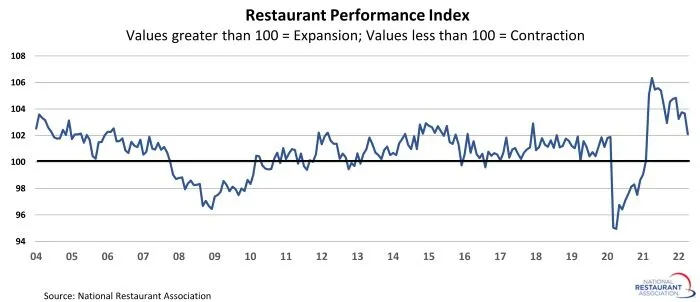
The Nationwide Restaurant Affiliation’s Restaurant Efficiency Index (RPI) fell sharply in April, as each the present scenario and expectations indicators registered broad-based declines. The RPI – a month-to-month composite index that tracks the well being of the U.S. restaurant business – stood at 102.1 in April, down 1.5% from a stage of 103.7 in March.
Identical-store gross sales and buyer site visitors readings had been considerably dampened in comparison with latest months, as many eating places had been up towards harder comparisons in April. Wanting forward, operators’ outlook for enterprise circumstances waned in latest months, which led to a fourth consecutive decline within the RPI’s expectations part.
The Present State of affairs Index, which measures present traits in 4 business indicators, stood at 102.3 in April – down 2.2% from a stage of 104.6 in March. All 4 of the present scenario indicators declined in April, led by softer same-store gross sales and buyer site visitors readings.
The Expectations Index, which measures restaurant operators’ six-month outlook for 4 business indicators, stood at 101.9 – down 0.8% from the earlier month and the fourth consecutive month-to-month decline. Though operators stay cautiously optimistic about gross sales development within the months forward, they’d a web unfavorable outlook for the general financial system for the third straight month.

RPI Methodology
The Nationwide Restaurant Affiliation’s Restaurant Efficiency Index (RPI) is a month-to-month composite index that tracks the well being of the U.S. restaurant business. Launched in 2002, the RPI is launched on the final enterprise day of every month.
The RPI is measured in relation to a impartial stage of 100. Index values above 100 point out that key business indicators are in a interval of enlargement, whereas index values beneath 100 signify a interval of contraction for key business indicators. The Index consists of two elements — the Present State of affairs Index, which measures present traits in 4 business indicators (same-store gross sales, site visitors, labor and capital expenditures), and the Expectations Index, which measures restaurant operators’ six-month outlook for 4 business indicators (same-store gross sales, staff, capital expenditures and enterprise circumstances).
The RPI relies on the responses to the Nationwide Restaurant Affiliation’s Restaurant Business Monitoring Survey, which is fielded month-to-month amongst restaurant operators nationwide on quite a lot of indicators together with gross sales, site visitors, labor and capital expenditures. Restaurant operators concerned about collaborating within the monitoring survey: contact Bruce Grindy.
For extra detailed evaluation of the RPI and Business Monitoring Survey knowledge, see Restaurant TrendMapper.
Watch the business replace here.