The restaurant trade’s labor market remained challenged throughout most states in January, primarily based on an evaluation of information from the Bureau of Labor Statistics (BLS). Forty states and the District of Columbia misplaced restaurant jobs between December and January, whereas solely 10 states noticed staffing ranges rise.
California misplaced a internet 71,200 consuming and ingesting place jobs in January, which was simply the most important decline among the many states that shed jobs. It additionally represented the state’s third consecutive month-to-month employment decline, which totaled 151,000 misplaced jobs.
New York (-25,300), Texas (-15,900), Georgia (-9,800), South Carolina (-9,600) and Massachusetts (-8,500) additionally registered sizable restaurant job losses in January.

With the discharge of the January 2021 state-level employment knowledge, BLS integrated its annual benchmark revisions. On account of these revisions, restaurant employment is now beneath the February 2020 pre-coronavirus stage in all 50 states and the District of Columbia.
In 11 states, restaurant employment was nonetheless down a minimum of 30% from the February 2020 stage. This group was led by the District of Columbia, which had 54% fewer consuming and ingesting locations jobs in January 2021 than it did in February 2020.
New York (-38%), Michigan (-36%), California (-35%) and Oregon (-35%) even have important deficits from their pre-coronavirus staffing ranges.

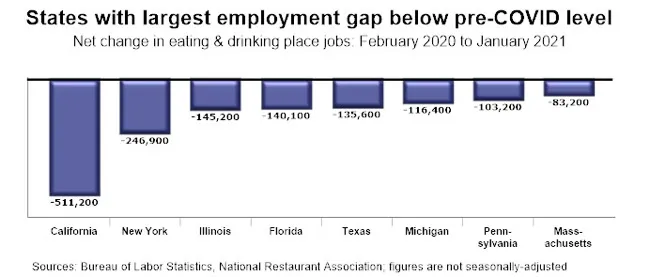
In uncooked numbers, California leads the best way with 511,200 fewer consuming and ingesting place jobs than it had in February 2020. Restaurant staffing ranges are additionally properly beneath pre-pandemic ranges in New York (-246,900), Illinois (-145,200), Florida (-140,100) and Texas (-135,600).

View the employment data for each state.
[Note: The BLS monthly employment dataset measures jobs during the payroll period that includes the 12th of each month. Changes in restaurant staffing levels – both negative and positive – have occurred rapidly during the coronavirus pandemic, as restaurants quickly adjust their operating status in response to evolving regulatory and economic conditions. As a result, significant changes likely occurred during the weeks between each measurement period, and the monthly data may not fully capture the total job losses experienced during the coronavirus lockdowns. Still, the figures are a useful indication of the extent to which restaurant employment is recovering in each state.]
*Consuming and ingesting locations are the first element of the full restaurant and foodservice trade, which prior the coronavirus outbreak employed 12 million out of the full restaurant and foodservice workforce of 15.6 million.
Learn extra analysis and commentary from the Affiliation’s chief economist Bruce Grindy.