The coronavirus pandemic is having a devasting affect on the restaurant trade and its staff. Consuming and consuming locations* misplaced greater than 6 million jobs in March and April, in line with preliminary knowledge from the Bureau of Labor Statistics (BLS).
[Note that these statistics only extended through the payroll period that included April 12, and likely didn’t measure the full extent of the job losses that continued in the weeks that followed. Based on two national surveys conducted by the National Restaurant Association in April and May, restaurant operators laid off or furloughed an estimated 8 million employees.]
As reported by BLS, there have been 6.3 million staff on payroll at consuming and consuming locations in April. This represented the trade’s lowest employment stage since Could 1988. General, eating places misplaced almost 3 times extra jobs than some other trade in March and April.
At this time’s BLS employment report illustrates the resiliency of the restaurant trade. As eating places began to reopen in communities massive and small, staff had been being rehired. Consuming and consuming locations added almost 1.4 million jobs in Could, in line with BLS. That’s almost 3 times extra job beneficial properties than the subsequent closest trade (building corporations added a internet 464,000 jobs in Could).

This job development is in step with a current Nationwide Restaurant Affiliation survey of restaurant operators. In a nationwide survey carried out in mid-Could, 62 % of restaurant operators who laid off or furloughed employees mentioned they rehired a few of these staff in current days or perhaps weeks. On common, these operators rehired 48 % of the staff that had been laid off or furloughed.
Furthermore, 61 % of restaurant operators mentioned they anticipate including extra staff to payroll throughout the subsequent 30 days.
Because of this, the expectation is that the trade’s unprecedented employment decline is over, barring a serious second wave. Nevertheless, don’t search for restaurant staffing ranges to return to regular anytime quickly. When requested within the Affiliation’s Could monitoring survey, two-thirds of restaurant operators mentioned they don’t count on their worker headcount to return to pre-coronavirus ranges earlier than the top of 2020.
Job losses different considerably by section
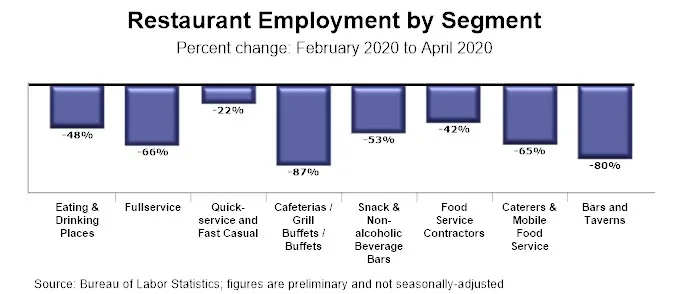
Whereas the coronavirus-related job losses had been widespread throughout the restaurant trade, some segments had been impacted greater than others. The cafeterias/grill buffets/buffets section lower 87 % of its workforce between February and April, in line with BLS. Staffing ranges at bars and taverns plunged 80 % throughout the two-month interval.
Employment within the fullservice section fell by two-thirds between February and April, whereas payrolls at snack and nonalcoholic beverage bars shrunk 53 %.
The quickservice and quick informal segments fared comparatively higher, as most of those operations had been already well-equipped to deal with off-premises site visitors – the one choice out there for a number of weeks. Staffing ranges at quickservice and quick informal institutions fell 22 % between February and April – the smallest decline out of the key trade segments.
*Consuming and consuming locations are the first element of the entire restaurant and foodservice trade, which prior the coronavirus outbreak employed 12 million out of the entire restaurant and foodservice workforce of 15.6 million.
Learn extra analysis and commentary from the Affiliation’s chief economist Bruce Grindy.