Consuming and ingesting locations* added a internet 285,900 jobs in February on a seasonally-adjusted foundation, in accordance with preliminary knowledge from the Bureau of Labor Statistics (BLS). Regardless of the wholesome enhance, restaurant staffing ranges stay 2 million jobs – or 16% – beneath pre-coronavirus ranges.
On the state degree, employment tendencies had been usually optimistic in February. Forty-three states and the District of Columbia added restaurant jobs between January and February, whereas solely 5 states skilled job losses within the restaurant trade. Restaurant employment was primarily unchanged in New Hampshire and South Dakota.
California added a internet 91,400 consuming and ingesting place jobs in February – tops among the many states that expanded payrolls throughout the month. It additionally reversed three consecutive months of employment losses within the state.
Michigan (46,200), New York (24,800) and Illinois (22,400) additionally adopted three straight months of job losses with stable good points in February.

Though a majority of states added restaurant jobs in February, employment ranges remained beneath their pre-pandemic readings in all 50 states and the District of Columbia.
In 3 states and the District of Columbia, restaurant employment was nonetheless down a minimum of 30% from the February 2020 degree. This group was led by the District of Columbia, which had 50% fewer consuming and ingesting locations jobs in February 2021 than it did in February 2020.
New York (-34%), Hawaii (-32%) and Vermont (-31%) even have vital deficits from their pre-coronavirus staffing ranges.

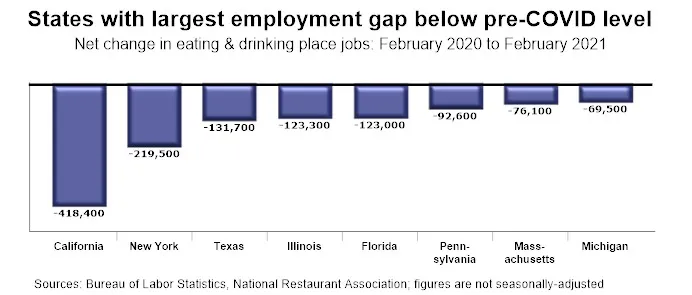
In uncooked numbers, California leads the way in which with 418,800 fewer consuming and ingesting place jobs than it had in February 2020. Restaurant staffing ranges are additionally effectively beneath pre-pandemic ranges in New York (-219,500), Texas (-131,700), Illinois (-123,300) and Florida (-123,000).

View the employment data for each state.
[Note: The BLS monthly employment dataset measures jobs during the payroll period that includes the 12th of each month. Changes in restaurant staffing levels – both negative and positive – have occurred rapidly during the coronavirus pandemic, as restaurants quickly adjust their operating status in response to evolving regulatory and economic conditions. As a result, significant changes likely occurred during the weeks between each measurement period, and the monthly data may not fully capture the total job losses experienced during the coronavirus lockdowns. Still, the figures are a useful indication of the extent to which restaurant employment is recovering in each state.]
*Consuming and ingesting locations are the first element of the whole restaurant and foodservice trade, which prior the coronavirus outbreak employed 12 million out of the whole restaurant and foodservice workforce of 15.6 million.
Learn extra analysis and commentary from the Affiliation’s chief economist Bruce Grindy.