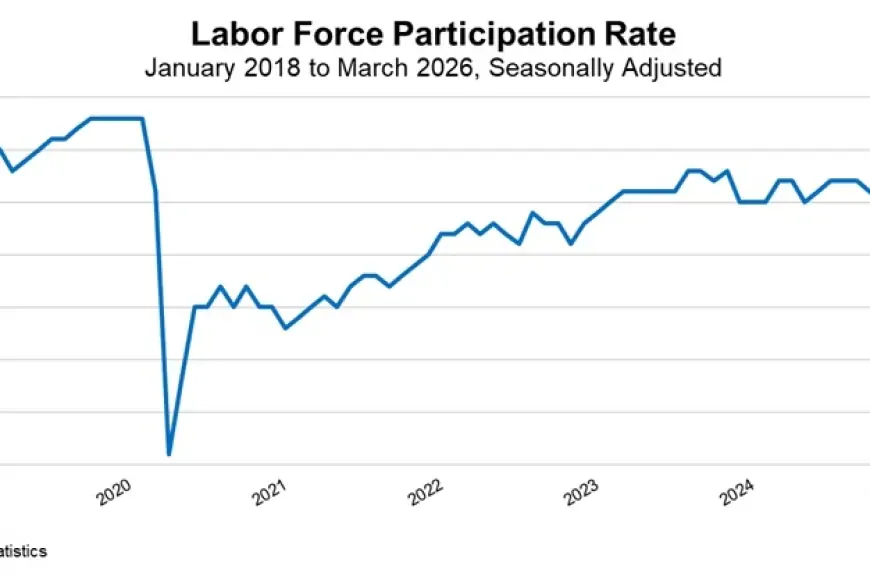
In November 2023, the labor drive participation fee reached 62.8%, marking the third time in 4 months that yr it hit that stage. These readings had been the strongest since February 2020 (63.3%), signaling that extra folks had been re-entering the workforce and serving to to ease labor shortages within the wake of the pandemic. This was welcome information for eating places and different companies struggling to recruit and retain staff, and a stronger labor market offered added resilience for the U.S. economic system.
That interval coincided with the peak of the so known as “Nice Resignation,” when the labor market was so tight there have been roughly two job openings for each unemployed employee. Since then, situations have cooled significantly, giving approach to what may be described because the “Nice Keep,” with each staff and employers settling right into a holding sample marked by much less job switching.
In immediately’s labor market, extra potential staff have additionally moved to the sidelines. The civilian labor drive has contracted sharply over the previous yr, falling from 128.69 million in March 2025 to 123.84 million in March 2026. On the identical time, the labor drive participation fee edged down from 62.0% in February to 61.9% in March, the bottom stage since November 2021.

By gender, labor drive participation has declined for each women and men over the previous yr or so, although the tempo of decline has been notably steeper for males. Amongst males, the participation fee peaked at 68.4% in November 2023, the very best stage since March 2020, earlier than sliding to 67.0% in March 2026. That represents a 0.8 proportion level decline over the previous 12 months and the bottom studying since Could 2020.
Amongst ladies, labor drive participation peaked at 57.8% in August 2024 and has since edged all the way down to 57.1% in March 2026. Not like the sharper pullback seen amongst males, the feminine participation fee has largely stabilized over the previous yr, averaging 57.2% throughout the previous ten readings.

The steepest labor drive participation declines have been amongst these youthful than 25 and people 55 or older. For youngsters (16–19), participation peaked post-pandemic at 38.2% in October 2023 however fell to 34.8% in August 2024, the bottom since August 2020. It has picked up considerably since then, measuring 35.7% in each February and March 2026, which was additionally the common seen over the previous 9 readings.
Amongst younger adults (20–24), participation has additionally trended decrease, slipping from 72.3% in January 2024, the very best since October 2019, to 70.5% in March 2026. That was the second-lowest studying—with the opposite being 70.3% in August 2025—since early 2021.
For staff 55 and older, demographic components are key, with extra people retiring, significantly because the pandemic. In February 2020, participation for this group was 40.3%, close to the report excessive of 40.7% set in late 2012 and early 2013. That share dropped to 37.2% in March 2026, the bottom since June 2025.
In contrast, participation amongst “prime-age” staff (25–54) has held comparatively regular, averaging 83.6% since January 2024 and registering 83.8% in March 2026. It hit 84.0% in January, the very best since March 2001, with the present fee simply shy of that latest peak.

These findings reinforce a transparent publish pandemic development: younger males stay the most certainly to be on the sidelines of the labor drive. This underscores the necessity for policymakers and companies alike to develop methods to attract extra of them again into the labor market—efforts that might assist ease workforce shortages by increasing the general provide of labor.
This problem carries explicit significance for the restaurant business, which has lengthy served because the nation’s main coaching floor. Greater than half of all U.S. adults held their first job in a restaurant, and greater than 67% have labored within the business sooner or later of their lives. Merely put, eating places have influenced the profession paths of extra folks than some other sector.
As labor drive participation amongst younger folks declines, fewer youngsters are having access to these formative early work experiences, and the important abilities that include them, which have lasting implications for each particular person profession trajectories and the broader economic system. On the identical time, the dearth of participation amongst this group represents an amazing alternative for eating places and different companies as they’re on the lookout for potential staff to fulfill their staffing wants.
Maybe extra hanging is the development amongst these with not less than a bachelor’s diploma. Labor drive participation for essentially the most educated staff fell to 71.4% in February 2026, a report low in knowledge courting again to 1992, earlier than ticking up solely marginally to 71.5% in March. This sample probably displays efficiency-driven staffing reductions throughout each the non-public and public sectors, pointing to a more difficult labor market even for increased expert staff. It additionally aligns with widespread anecdotal reviews that discovering employment immediately is harder than it was a yr or two in the past.